

XMAS BOOK MARKET 2018
by Drucken Heften Laden & Friends
with e-books, printed matter, drinks and snacks
Wednesday Dec 19th
5 to 9 pm
EECLECTIC Office
Lindenstraße 91
10969 Berlin-Kreuzberg
…
by Drucken Heften Laden & Friends
with e-books, printed matter, drinks and snacks
Wednesday Dec 19th
5 to 9 pm
EECLECTIC Office
Lindenstraße 91
10969 Berlin-Kreuzberg
…
Eine Revision der
Berliner Projektekultur
1. und 2. Dezember 2018
Hebbel am Ufer, HAU1
…

Sunday, 14 December, 2025 | 2:00pm — 8:00pm
Our yearly XMAS BOOK MARKET
EECLECTIC Studios
Visit us, as you do every December, at the cutest book and e-book fair for independent publishers and artists! There will be books, fanzines, e-books, short presentations, readings, white mulled wine, Christmas cookies, soup and performances. So walk through the softly falling snow (no guarantees on our part) to the EECLECTIC studio. Read, listen, talk, eat, shop, and go home with your heads, bags, and bellies full into the clear winter night ❄️🌃✨
…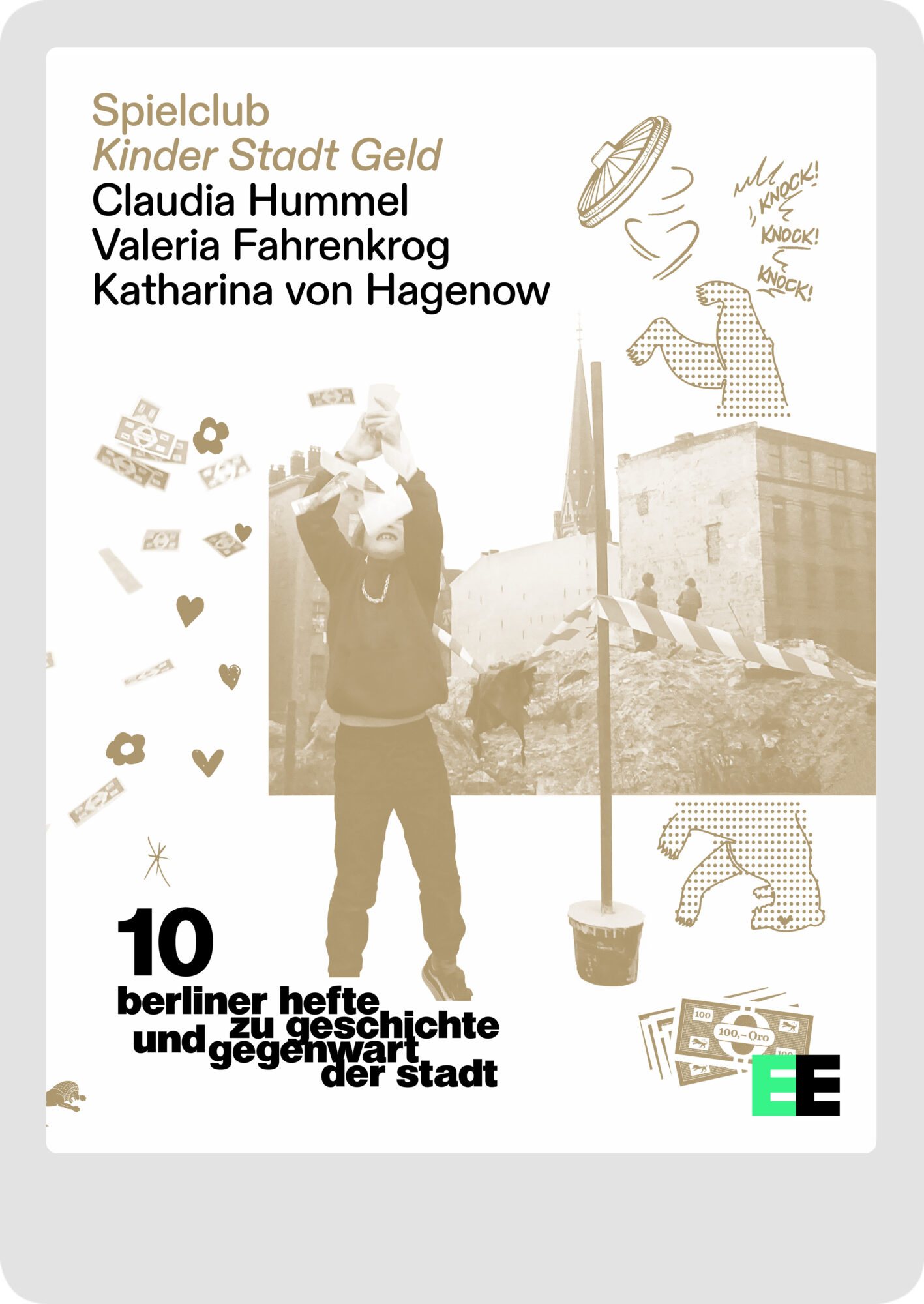
From 1969 to 1971, a working group at the neue Gesellschaft für bildende Kunst (nGbK) developed a form of play critical of capitalism for and with working-class children. Over the course of several months, artists and young residents of the Kulmer neighborhood in Berlin-Schöneberg devised alternatives to the promises of the toy industry. In this so-called Spielklub (play club), a play city was created in which the mechanisms of capitalist economic activity could be experienced and thus made transparent.
Reactivated in the winter of 2019/20 at the nGbK, the Spielclub Oranienstraße 25 offered Berlin school classes the opportunity to play in a model of Kreuzberg’s Oranienstraße. The focus remained on pressing issues of urban development, including rental policy and participation in social change. With money always playing a central role.
Some of the children’s questions were:
“So what’s the hotel owner up to with the mayor?”
“Who owns the wasteland?”
“What’s missing here, on our street?”
“Can anyone actually win the game in the play club?”
This publication locates the historical play club within both the trajectory of ideas of self-governed children’s republics and in the context of artistic-activist projects of the 1970s. Spielclub. Kinder Stadt Geld reflects on the relationship between children and artists, play and reality and shows the differences between the projects realised 50 years apart.
The e-book is supplemented by a film excerpt on the Spielstadt in the Märkisches Viertel, a temporary extension of the Schöneberg Spielklub from June 1971, as well as two audio contributions.
Produced on the occasion of Spielclub Oranienstraße 25, nGbK, 2019/20
Fri 20 – Sun 22 October
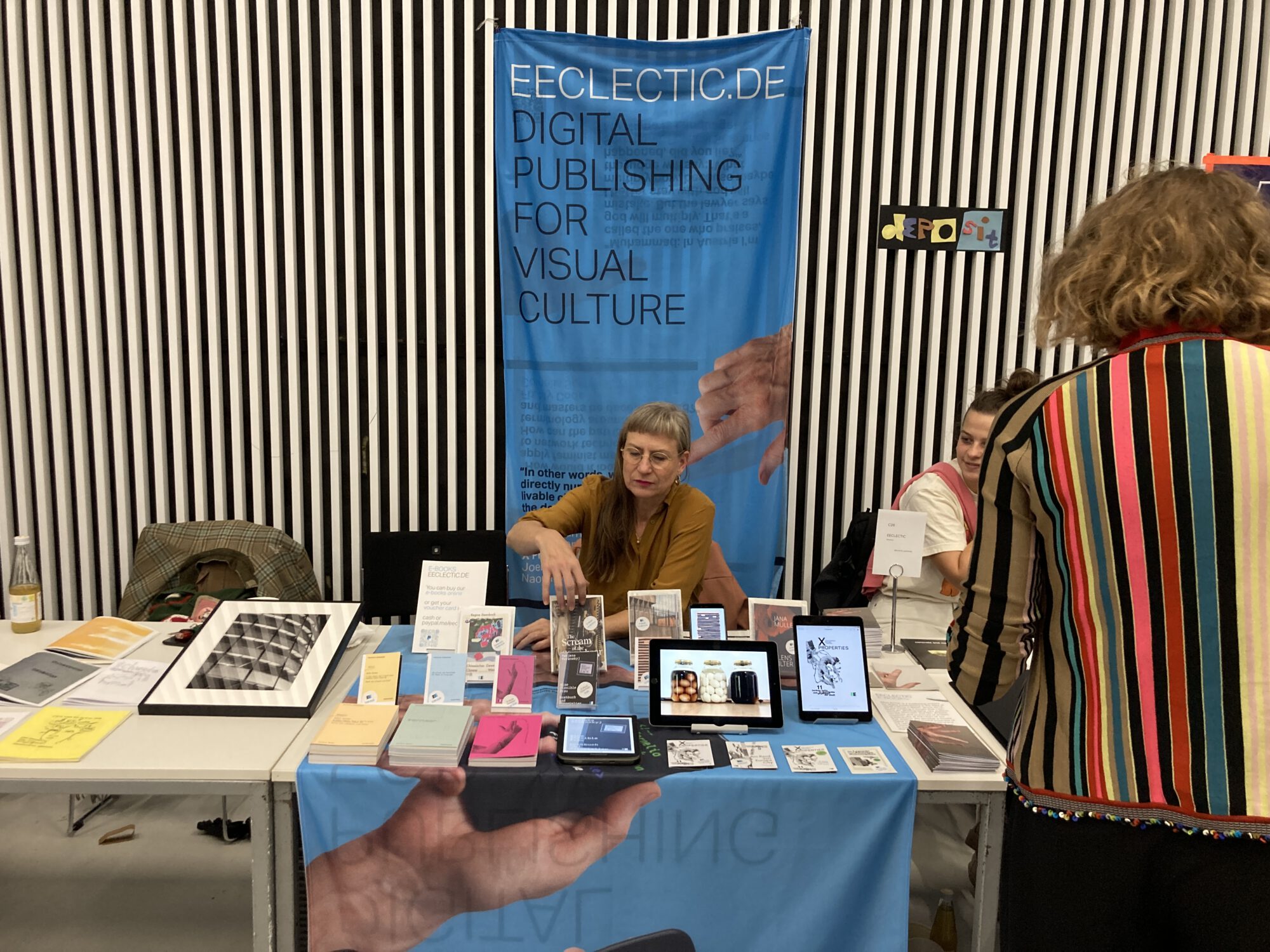
Over the course of three days the Vienna Art Book Fair #2 provides a platform for artists, collectives, self-publishers, small publishing houses, antiquarian booksellers, art libraries, institutions, printers, collectors and for all those who are dedicated to the medium of the book.
Die Angewandte – University of Applied Arts Vienna
Vordere Zollamtsstraße 7, 1030 Vienna, Austria
Friday, Oct 20, 5 – 9 pm
Saturday, Oct 21, 1 – 7 pm
Sunday, Oct 22, 12 – 6 pm
🔥E-Book-Präsentation und Gespräch
Verplaatst auf der @viennaartbookfair 📚
Sonntag, 22. Oktober 2023
14:30 Uhr
@viennaartbookfair
Project Room 3
Die Angewandte – University of Applied Arts Vienna
Vordere Zollamtsstraße 7
1030 Wien, Österreich
viennaartbookfair.com
Freier Eintritt
Verplaatst – E-Book zum städtebaulichen Wandel der Stadt Rotterdams 📷
Die Künstlerin Annette Kisling im Gespräch mit Kunst- und Kulturwissenschaftlerin Regine Ehleiter über die umfangreiche fotografische Reihe Verplaatst, die einen komplexen Eindruck der städtebaulichen und zugleich gesellschaftlichen Veränderung Rotterdams wiedergibt. Annette Kislings künstlerisches Werk umfasst zahlreiche fotografische Reihen, die ihre Auseinandersetzung mit der vielschichtigen Bedeutung der uns umgebenden Architektur wiedergeben. Verplaatst ist 2023 bei EECLECTIC erschienen.
Lesenswert dazu die schöne Besprechung von Carolin Förster in der Camera Austria 163/2023
„Die Besonderheit einer digitalen künstlerischen Publikation liegt nicht unbedingt in der Bereitstellung besonderer technischer oder audiovisueller Anwendungen, wie Verplaatst eindringlich zeigt. Schließlich verzichtet Kisling zugunsten des Bildes auf jede Erläuterung zu Geodaten ,Bauten, Architekt*innen. Auf das Format selbst bezogen ist es die wendig-flexible Navigation auf verschiedenen Geräten – Smartphone, Tablet, Rechner –, die eine andere Rezeption der Inhalte formen könnte. Dazu tritt mit der digitalen Distribution eine andere Logistik. Grundsätzlich eröffnet das E-Book Optionen – kein Ersatz für das Fotobuch, sondern eine Variation.”
Mit weiteren Publikationen von: @matthew___cowan @economicwords @jana_mueller_berlin @reginesteenbock #eineflexiblefrau
@emmawolfhaugh @berlinerhefte
@reginee @annette.kisling @cameraaustriagraz @viennaartbookfair
eeclectic #viennaartbookfair #artbookfair #vienna #annettekisling #verplaatst #independentpublishing #indieverlag #supportindependentpublishing #supportsmallpublishers

Berlin’s real estate market is still booming, neighbourhoods are “developed”, people are forced out of their living environments. Residential, work and commercial spaces become investments for real estate corporations, trust funds, and anonymous owners, while a politicized tenants’ movement demands the right to the city for all.
But who are the real players behind the economic exploitation of urban space? What allows them to act the way they do – and how can their actions be politically and societally monitored, controlled, and thwarted?
X Properties examines the impact of financial capital on the social and cultural production of the city, its forms of relationality and subjectivity. The book is published on the occasion of the homonymous research and event project at neue Gesellschaft für bildende Kunst (nGbK). The text contributions by Christian (Syndikat-Kollektiv), Christoph Casper, Jana Gebauer, Kathrin Gerlof, Katrin Lompscher, Louis Moreno, Raquel Rolnik & Isadora Guerreiro & Paula Freire Santoro and Pheli Sommer combine Berlin case studies with global perspectives on the de/financialisation of the city.
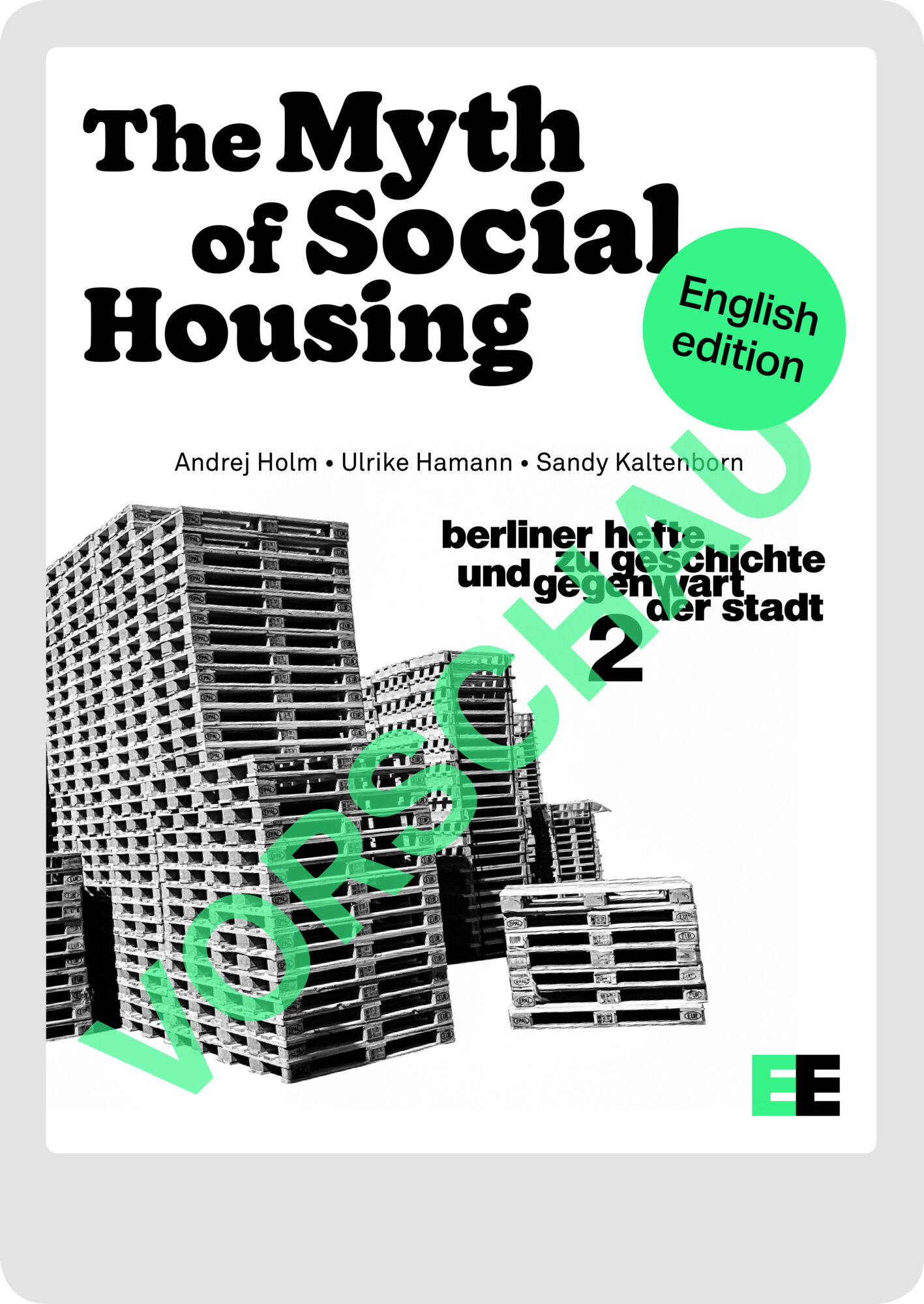
For some time now, the housing question has once again been a subject of public debate: the issue of housing provision for those who have nothing to gain from a booming real estate market. This also includes people seeking refuge. The response to demands for more social housing, however, is limited: there has not been enough new construction to compensate for the number of social housing units lost due to the expiry of occupancy commitments for publicly assisted housing. But is the social housing system even capable of guaranteeing low rents in the long term?
This publication clears up misunderstandings and explains why social housing of the sort built in the German Federal Republic and West Berlin is a myth. Instead of meeting the long-term needs of low-income households it has so far primarily been about promoting economic development and private property ownership, instead of meeting the long-term needs of low-income households. This is reason enough to examine the principle of social housing and ask why it is so difficult to reform.
The third, revised edition of The Myth of Social Housing provides updated figures and content in Andrej Holm’s text, as well as a new introduction by the editors, Ulrike Hamann and Sandy Kaltenborn, which reflects on Berlin’s housing policy changes of the last ten years.
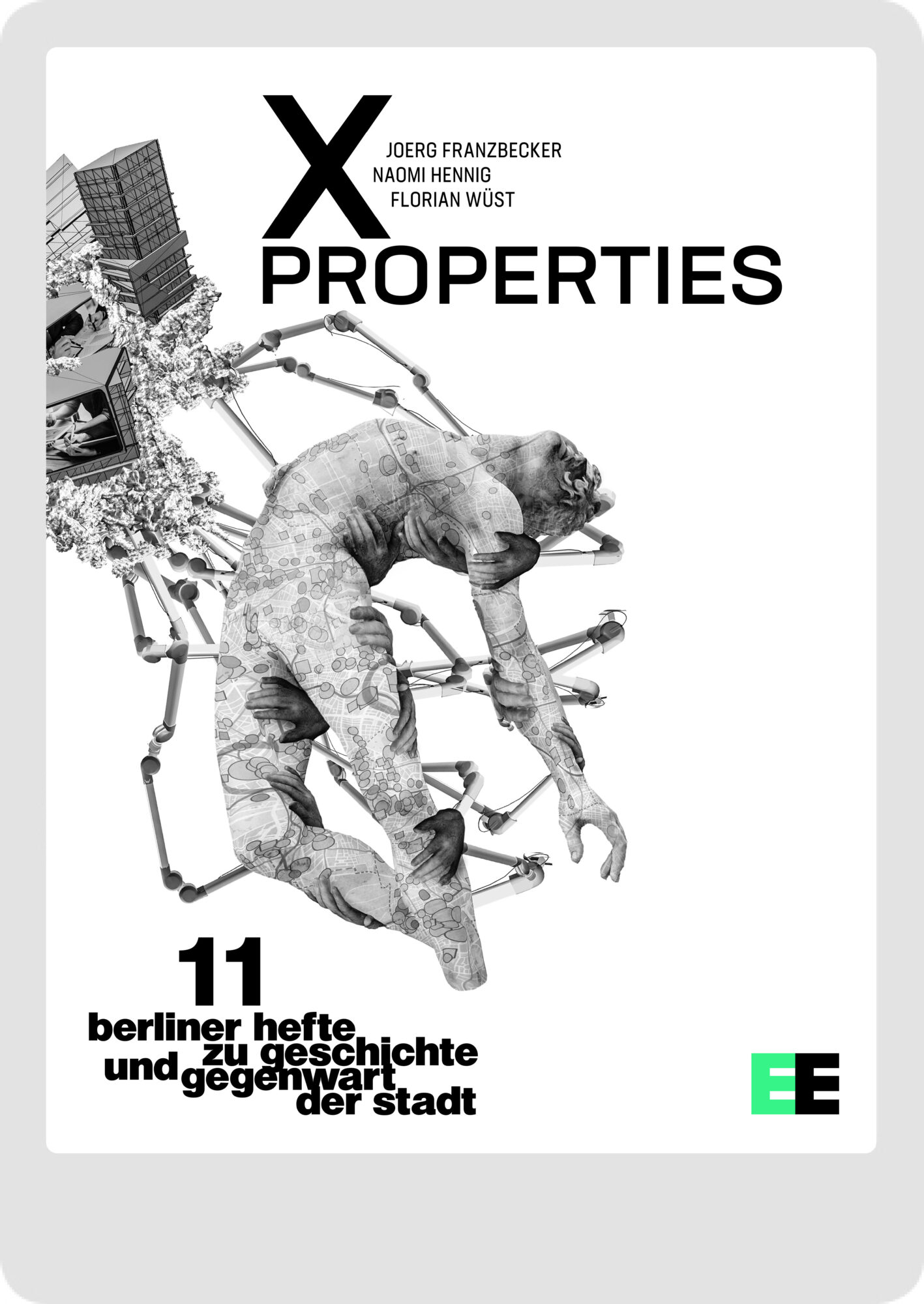
Berlin’s real estate market is still booming, neighborhoods are “developed”, people are forced out of their living environments. Residential, work and commercial spaces become investments for real estate corporations, trust funds, and anonymous owners, while a politicized tenants’ movement demands the right to the city for all.
But who are the real players behind the economic exploitation of urban space? What allows them to act the way they do – and how can their actions be politically and societally monitored, controlled, and thwarted?
X Properties examines the impact of financial capital on the social and cultural production of the city, its forms of relationality and subjectivity. The book is published on the occasion of the homonymous research and event project at neue Gesellschaft für bildende Kunst (nGbK). The text contributions by Christian (Syndikat-Kollektiv), Christoph Casper, Jana Gebauer, Kathrin Gerlof, Katrin Lompscher, Louis Moreno, Raquel Rolnik & Isadora Guerreiro & Paula Freire Santoro and Pheli Sommer combine Berlin case studies with global perspectives on the de/financialisation of the city.
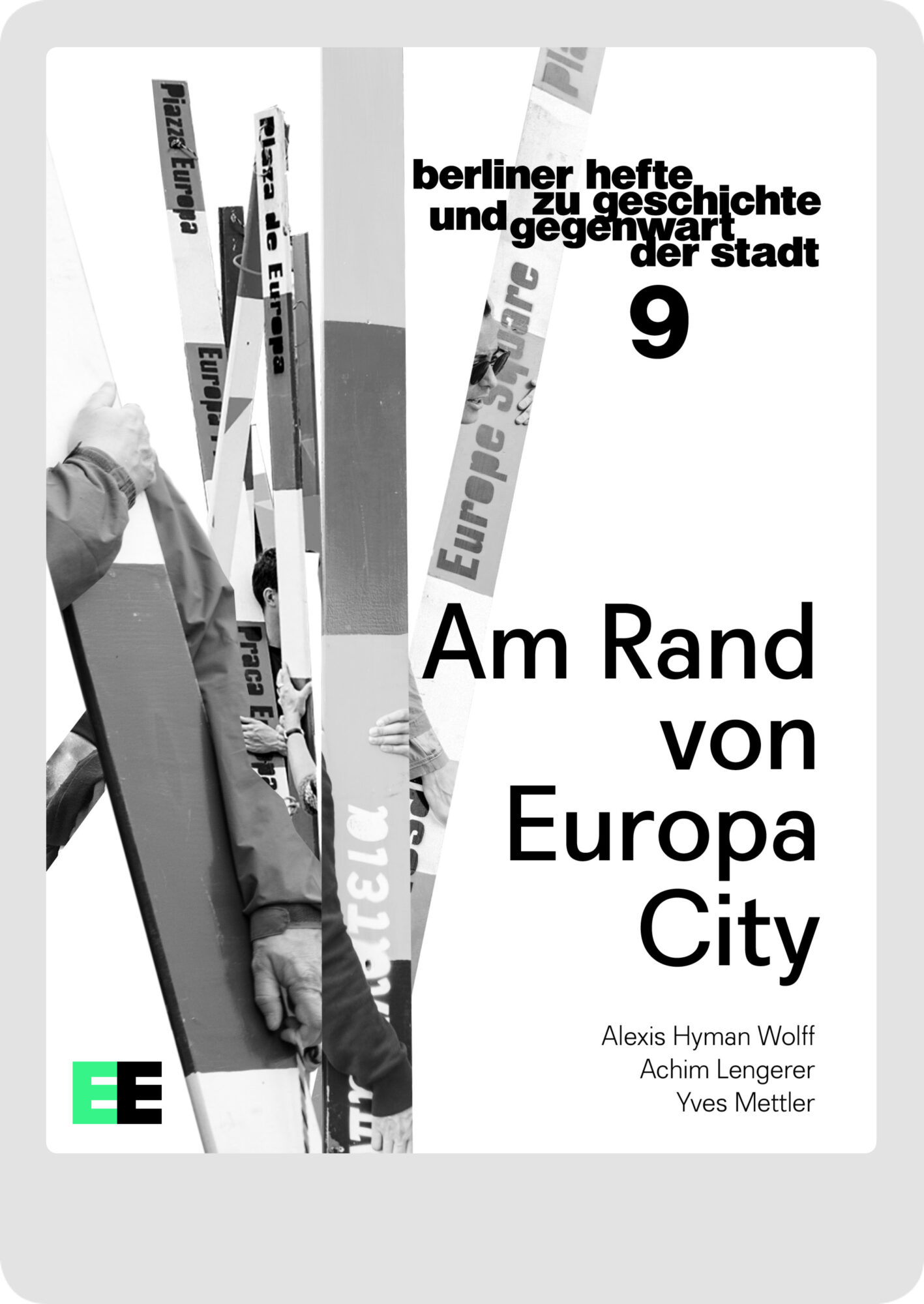
North of Berlin’s main railway station, a new district with several hundred thousand square metres of office space and 3,000 flats has been growing since 2012: Europacity. The huge urban development project on former railway land is being realised by private real estate companies in close partnership with the Berlin Senate. Europacity stands for a neoliberalisation of the city that destroys existing neighbourhood structures and produces exclusion and displacement.
The journal tells the story of the development of Europacity, which generated virtually no public debate until shortly before its completion. A collage of voices documents the view of Europacity from the perspective of the neighbouring districts. The text contribution by political scientist Teresa Pullano deals with the connections between a historical-cultural image of Europe and forms of economic and political capital as they appear in Europacity.
The research and field reports were developed as part of the artistic project Am Rand von EuropaCity (2018/19), which brought residents, artists and theorists into conversation with each other through processes of ‘collective listening’.
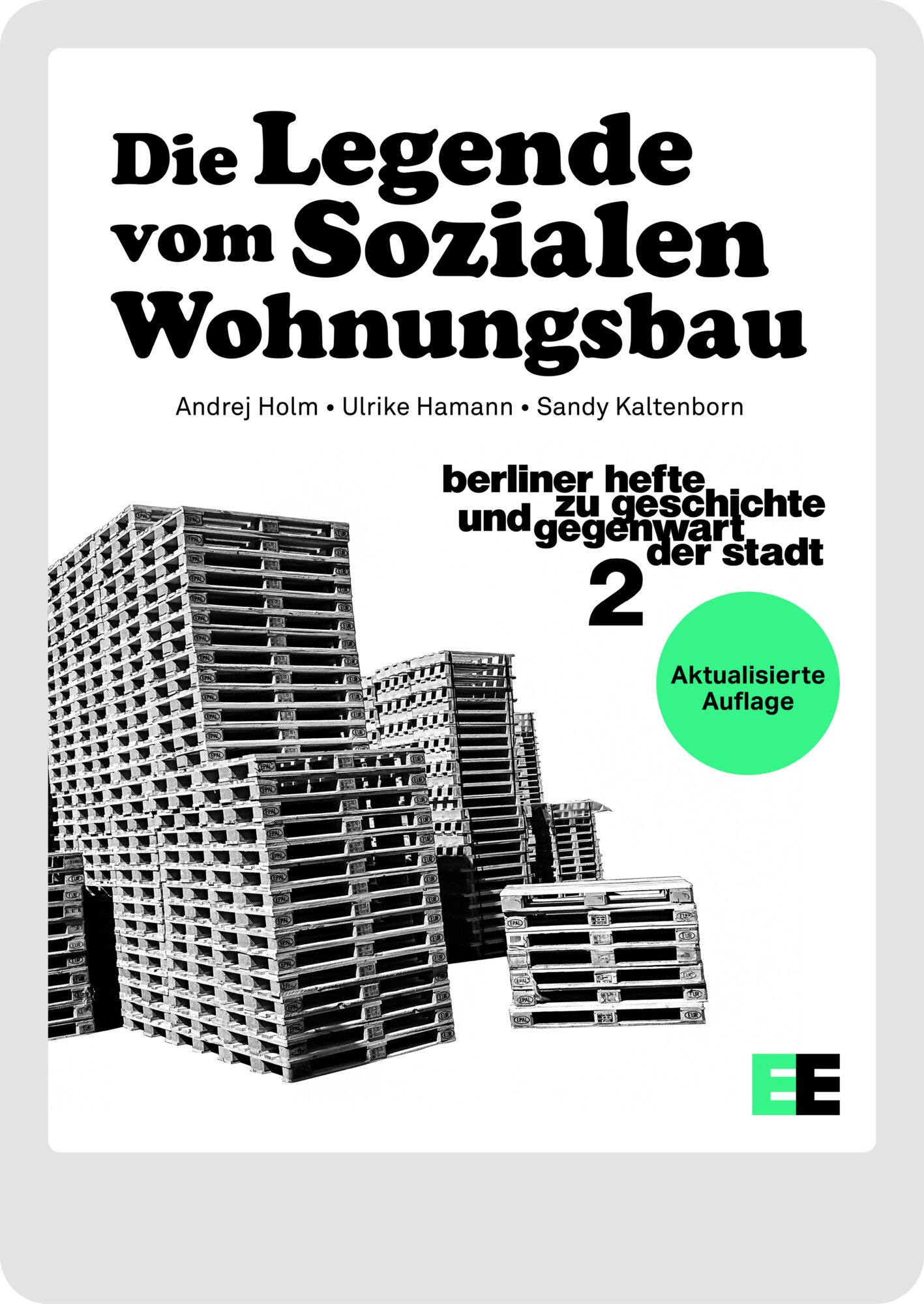
The Myth of Social Housing
For some time now, the housing question has once again been a subject of public debate: the issue of housing provision for those who have nothing to gain from a booming real estate market. This also includes people seeking refuge. The response to demands for more social housing, however, is limited: there has not been enough new construction to compensate for the number of social housing units lost due to the expiry of occupancy commitments for publicly assisted housing. But is the social housing system even capable of guaranteeing low rents in the long term?
This publication clears up misunderstandings and explains why social housing of the sort built in the German Federal Republic and West Berlin is a myth. Instead of meeting the long-term needs of low-income households it has so far primarily been about promoting economic development and private property ownership. This is reason enough to examine the principle of social housing and ask why it is so difficult to reform.
The second, revised edition of Die Legende vom Sozialen Wohnungsbau provides updated figures and content in Andrej Holm’s text, as well as a new introduction by the editors, Ulrike Hamann and Sandy Kaltenborn, which reflects on Berlin’s housing policy changes of the last ten years.